Showing posts with label Mod/Severe. Show all posts

Wednesday, October 12, 2016

The Moderate/Severe Population: Structuring Therapy Sessions

Over the years, I've realized that when working with students in my Mod/Severe classes, my sessions are most successful when they include several parts that we can "check-off" on an agenda, visual schedule, etc. This is most necessary for my students with behaviors who have limited attention and need to constantly be looking towards the next activity. For example, here's a re-usable visual schedule I use with a student who has particular difficulty attending to tasks for more than a minute or two.

Thus, the clinical question I realized I needed to answer was this: what activities can I do with my Mod/Severe students to break-up an otherwise long, single activity?

What Do My Mod/Severe Sessions Look Like?

My Rules ~ 1 - 2 minutes
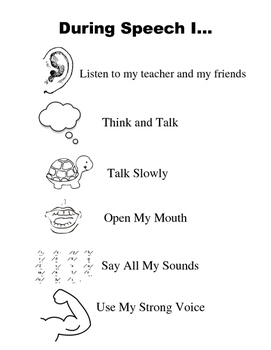
As I mentioned in my very first post about working with this population, I always start out by quickly going over the "rules" to get everyone in the mindset of participating and focusing on their good speech strategies. You can find my rule sheet here, although I have recently been contemplating updating it to include an AAC rule since I have several new AAC users this year.

Warm-Up ~ 3 - 7 minutes
I like to do some sort of quick activity to get my students talking and ready to engage in the main activity for the day.
- For my lowest-functioning class, I use the free "Touch and Say" app and open different pages for different students: the "silly" page for students working on imitation, "feel" page to quickly target some emotions, or "color" to work on some basic functions. It may look juvenile with the little mouse-looking creature, but on the actual pages there is no mouse, just a solid color with a "Nick Jr."-esque face. It ends up being much more neutral than some of my students other preferred interests (e.g. Thomas the Train, Dora, etc.).
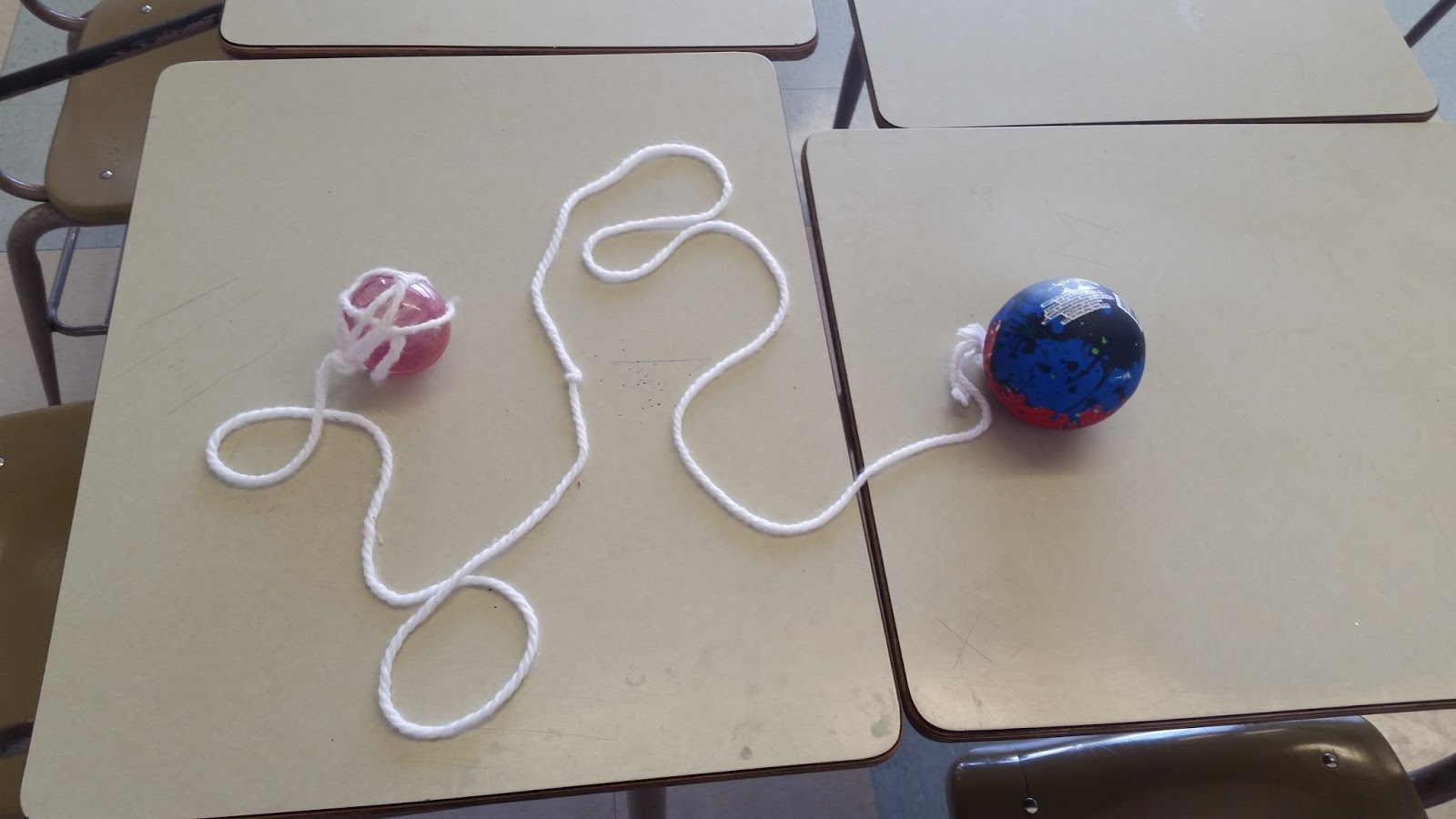

- For my higher functioning classes, I created the "Conversation Balls." Essentially, it's two dollar store balls (one big, one small) that I hot-glued a long string between to connect. The game is played by selecting a student who gets the big ball and a target prompt (e.g. "What did you do over the weekend?" or "What's your favorite food?"). The student then throws the small ball to a peer and asks them them target question. The string connects the two balls, serving as a good reminder for students to use eye contact and face their conversational partner. After the student with the big ball makes a comment, the student who had the small ball selects someone else to be their partner and then they receive the big ball. I prompt as needed for the students to make comments, ask/answer questions, etc as the balls get passed around the room between all the students.

**For some groups, the conversation ball can be so time consuming that it can take up an entire session; it really depends on how well your students can ask and answer questions**

- If an exciting topic has recently happened, such as Christmas or summer vacation, I may just ask the students to go around and each share one thing that's on their minds. They get to practice their language skills (because most of their day is spent in total silence!) and I get to learn more about their lives! It's a win-win.

Main Activity ~ 15 min - 25 min
You can check out some of my "main activities" that I have posted about in the past here and here. You can also check out my blog post here where I describe some of my favorite "off-the-shelf" materials, some of which I have used with my higher-functioning Mod/Severe students as "main activities." There's many other activities that will one day make it into a blog post, such as using themed surveys to ask and answer questions, re-telling short animated clips, using News 2 You, and modifying traditional games like bingo and go fish to target functional communication and intelligibility. Stay tuned for more ideas for working with this population in the future!

Wrap-Up/Reward/Transition ~ 1 - 5 minutes
With my higher-functioning classes, we always do a quick wrap-up to discuss what we were targeting that day - such as new vocabulary, explanation skills, good speech skills, social skills, etc. This is an important part of any session, but I actually forgot to implement a wrap-up with my Mod/Severe students until this year... whoops! They need the reminder of what they were working on as well!

You may also have some students/classes that need to be working for a reward. I typically implement a short, funny video as the reward since it can target an entire class and be over within 60 seconds or less. Popular google searches for appropriate and enjoyable videos include "dog dancing," "funny cats," and other animal-related videos. I also try to schedule my sessions at the end of a class period so that when my session ends, the students are ready to transition to their next classroom or activity. I feel like this gets some teacher buy-in as well, because the students are completely finished with an activity and are generally willing to transition with little difficulty.

I think the key take-away in planning sessions for the Mod/Severe population is to always try to plan for any crazy thing that may happen and to then have some sort of back-up in mind! Behavior issues? Have that visual schedule, Class Dojo, or reward system ready to go. Session not going well? I keep the students' favorite Matt and Molly stories in my Mod/Severe therapy bag just to whip out in case things go south.

What are your favorite ideas to keep your Mod/Severe sessions running smoothly? How do you handle behavior issues or keep your students focused on your activity? Please share your ideas in the comment section!!

As always, it doesn't have to be fancy, just keep it fun and functional!
  • Jillian, the No-Frills SLP

Wednesday, August 17, 2016

The Mod/Severe Population: Matt and Molly, Not Just For the Littles!


        Last year when I was taking stock of all the things I inherited from the previous SLP, I noticed a wide assortment of Matt and Molly kits, which you can find at LinguiSystem's website here. Matt and Molly kits consist of sequences of 4 pictures that use stick figures to explain daily activities, interactions, and themes (e.g. seasons, animals, etc.) that come with pre-scripted sentences to say about each picture. They are simple, colorful, and targeted towards working with students with Autism. They are structured to include an introductory scene, 2 "bad choices," and 1 "good choice."


        My previous experience with these sets of pictures had been in grad school where I used them with young children. I wondered to myself, "Why are these here at the high school?" Every single one was still in the shrink wrap, so I knew the previous SLP hadn't even attempted to use them. Maybe they were sent to the wrong school? Maybe she ordered the wrong item? There were certainly other very juvenile items in my room; I was tempted to toss them in the pile of items I didn't want. But they weren't that juvenile - Matt and Molly are drawn so vaguely that they easily could be viewed as pre-teens and the situations they find themselves in are not only applicable to small children!

        I had an idea. Many of the students in my Mod/Severe classes fit the cognitive profile of the target audience for Matt and Molly - why not develop use of the Matt and Molly stories for my exceptional learners?

Matt and Molly Are Secretly Teenagers

       I quickly learned that not every Matt and Molly sequence is appropriate for the adolescent Mod/Severe classroom. I removed the sequence that involved hand-holding when crossing the street (because we teach other strategies for street safety). I removed the sequence that taught how to hug relatives (because I believe all of our kids should be allowed bodily autonomy and not be forced to hug a relative if they don't want to). I removed a few other stories that were just plain silly and too immature for teenagers.

       But what did I find was appropriate? I discovered a sequence on using a tissue and not your sleeve - an issue that plagued the classrooms for weeks this winter. I tweaked several sequences about how to ride the bus. There are sequences for standing in line, touching dogs, interacting with guests, and greeting someone at the door. I realized that, even though they are made for young children, my students still needed to work on these life skills! In fact, Matt and Molly are sometimes so willfully defiant that I really think the creators modeled them after teenagers!

What Does a Matt and Molly Lesson Look Like?

         Every session with my Mod/Severe classes begins with a reminder of the rules, which you can find in my TPT Store here. Nowadays, my students are very familiar with Matt and Molly and will call them by their names. But on the first day, I introduced them as "new friends" and described them as teenagers who sometimes make bad choices. I told my students that Matt and Molly needed their help to figure out good choices.

         I laminated cards with a green "yes" and a red "no" on opposing sides. I instructed my students that after Matt and Molly make a choice, they will be asked to hold up their cards and vote on whether Matt and Molly are making the right choice. This is the main way my non-verbal, poorly engaged students are involved in the lesson. My verbal students also use the cards to vote, but in addition they are asked WH- questions about better choices. A few of the highest students can give explanations of why the poor choice is wrong.

        After introducing Matt and Molly, I reveal the introductory picture. In one classroom, there is a document camera I can use to project the image onto the SMARTBoard. In other classes, I assemble the students together in a group and show them the actual picture.

        When "telling the story," I never use the pre-scripted sentences that come with the sets because they are not language-rich and written for an audience of small children. Rather, I construct my own version that typically includes more details, target vocabulary, and appropriate conversational slang. I identify other characters in the picture (e.g. mom, dad, grandpa) by their name or I may ask students to make a guess who is in the picture.

       For example, in the example below, I asked my students to look at the character's height, dress, and haircut. Does this look like Mom? Why can't this character be Dad? (Lessons in my Mod/Severe classes are, unfortunately, not the best place to combat gender stereotypes based on appearance!). Typically my students require quite a bit of prompting, but understanding why this character can't be Dad targets important critical thinking skills.

In this sequence, we see Molly attempt 2 poor choices - grabbing the music and pulling hair - before coming up with the correct solution of getting her own headphones and music.

      For each picture, I ask the students some WH- questions. For example, the above pictures might elicit questions like "What does Molly see?" "Who has the headphones?" "Where is Molly's hand?" The Matt and Molly drawings also explicitly target emotions - I might ask "How is she feeling?" and point to Molly's friend's mouth as a cue to elicit the response that she is angry or happy.

      Continuing on in the progression, I typically reveal the second picture to be a bad choice although you can present the pictures in any order. The students generally find the poor solutions to be hilarious and will burst into laughter when they see Matt and Molly engaging is poor behaviors. For example, when Matt blows snot into his sleeve, they giggle and point at how silly Matt is. They, of course, need prompting to make the connection that that they too blow snot into their sleeves on a daily basis!

      After explaining the choice Matt or Molly has made, I ask more WH- questions and attempt to elicit explanations of why the choice was not a good one. At the end, we conduct a class vote and tally the number of "yes" and "no" on the class white board. Sometimes, the teachers then use these numbers in their math lessons to construct simple graphs and pie charts to demonstrate the concept of "most," "more," "less," "few," etc. (e.g. "Most people in the class thought Matt made a good choice!").

         At the end, you can also ask students to sequence the story themselves. Sometimes I ask students to stand in the front of the class and hold individual pictures in order to sequence them as a class. I have also contemplated scanning the pictures and shrinking them down to the size of a 3 x 5 card for each individual student to sequence at their desk, but I have not done this yet. Something to work on this year! It's also fun to ask the students to role play the situations - proper nose blowing and line forming work well for this activity!

         During a typical 30 minute session with 6 - 8 students, I use 2 or 3 Matt and Molly sequences. However, it would be possible to fill an entire session with 1 sequence if you conducted multiple different activities involving the same sequence.


Modifications
 - For my students with limited verbal abilities, I created conversation sheets with key icons that relate to the story. You can find an example here at my TPT store - it correlates to the "Hungry Turkey" Matt and Molly sequence found in the "Fall" set (see the picture above).
 - My students with AAC use their devices to comment and answer WH- questions. This year, my goal is to provide the para-educators with a vocabulary list ahead of time so they can program relevant vocabulary into students' AAC devices.
 - My students with intelligibility concerns use their strategies (explained here) when answering questions and practice target words related to the story (e.g. choice, stop!, rain, etc.)

       If you don't have access to "official" Matt and Molly materials, I would highly encourage you to make your own! The key takeaway here is that the students seem to really respond to simple drawings with relevant stories told in an interactive way. They love participating by voting and correcting me when I "accidentally" praise Matt for a bad choice! It doesn't have to be fancy, just make it fun!

As always, it doesn't have to be fancy, just keep it fun and functional!
  • Jillian, the No-Frills SLP


Wednesday, May 25, 2016

The Moderate/Severe Population: Telephone Scripting

Functional Communication: Where Does it Happen?

This year, I discovered that many students in my school’s 3 Moderate/Severe Special Day Classes have their own personal cell phones. This includes one student who is about 30% intelligible when context is known! Does that surprise you? It certainly surprised me.

As I began working with these students, it occurred to me that functional situations replete with language use happen every day over the phone. Even if some of my students do not have their own personal cell phones now, they likely will when they move onto their group homes or day program placements in the near future. And let’s be real, cell phones aren’t going anywhere. I decided it was imperative that these students graduate with functional phone communication skills.

Ring, Ring! ….Silence.

I started with a probe to see if my students could answer the phone. I handed an old, battery-less cell phone to one of my students and, using my own personal cell phone, I played a ringtone to simulate the student’s phone ringing. She excitedly held the old cell phone up to her ear, a grin on her face. She said nothing. I stopped the ringtone on my phone from sounding. Nothing. I cued her with an expectant face and waved my hand to motion her to say something. A solid 10 seconds later, she produced a “Hi, Ms. Hall!”
 

The rest of the class didn’t fare much better. We clearly had some work to do.

Powerpoint is My Best Friend!

Whenever I plan lessons for my Mod/Severe students, visuals are always my first thought. A few of them have basic reading skills, but most rely heavily on visuals for new learning. My go-to strategy for these classes is the ultimate, customizable visual tool: PowerPoint. Fortunately, all the classrooms I push-in to have SMARTBoards I can use to display powerpoints, videos, and other digital media to my students. If they did not, I would upload the PowerPoint onto my iPad and use is as handheld visual as I roamed about the class.

I set up a simple script that I wanted my students to learn for a specific phone situation: answering the phone and the person calling them actually needs to speak to someone else (e.g. their parent, teacher, caregiver, classmate, etc.).

The first time I ran this lesson with my classes, the script went as follows:
  1. Hi!
  2. Yes or No (in response to asking for the other speaker)
  3. It’s for you! (hand the phone over)


The Part 1 PowerPoint I used to teach this activity can be downloaded here at my TPT store: https://www.teacherspayteachers.com/Product/How-Do-We-Answer-The-Telephone-Phone-Scripting-Activity-2544908

Each student was able to practice this script with me twice in our allotted 30 minute session. Many of the students struggled with the overall concept; I knew this would become a recurring lesson to “keep in my backpocket.” Essentially, it shows up every so often in my rotation of classroom-based lessons. When I am feeling particularly uninspired, it’s an important relevant lesson to whip out in no time.

So, that brings me to  the second time I ran this lesson. I decided to add in a new step between 2 and 3: asking “Who is this?” For my students who were beginning to master the original lesson, this was a great step forward for them.


On the second time around, the students performed more independently overall; however, asking “Who is this?” was difficult when the students could see me at the front of the room. In the future, I may try asking several paraprofessionals to step outside of the room and actually have the students make a real phone call in order to practice asking “Who is this?” in a more realistic context (since they won’t know exactly who is calling them).

But back in what actually happened, I did turn the situation into somewhat of a game - the students quickly realized that each time they “answered the phone” that I would alter my voice to pretend to be a different staff member. They greatly enjoyed the farce of me pretending to be other staff members and it reinforced the necessity of asking the new question “Who is this?”

How Do I Differentiate This Activity?


  • My non-verbal students participated in this activity by selecting appropriate messages on their AAC systems (e.g. “Hi.” “How are you?” “Yes/No.” “Take this.”) to respond to the demands of the “caller.”
  • My students with intelligibility issues practiced their “good speech strategies” (see Blog Post #2 for more info) when speaking on the phone.
  • I have the ability to modify how long I “stay on the phone” in order to elicit more language from my students who have higher language skills. I can ask open-ended, social questions like “How are you?” “What are you doing right now?” and “How was your weekend?” I can ask closed questions like, “Are you busy now?” or “Are you at school?”

Furthermore, as a carry-over strategy, I encouraged the teachers in the class to allow the students to practice by answering the classroom phone. Our school phones list the last name of the school personnel that’s calling, so I suggested that they make decisions about which teachers or staff members would be the best conversational partners and to have the students answer the phone when those specific staff members call (Because realistically, not all staff at my school would make good, patient, conversational practice models for my students!).

I hope that you find that you can easily implement this activity with the Mod/Severe population. I love this activity in particular because students can always use more practice with phone skills and it takes very little preparation now that I created the PowerPoints. And even better, the students have great fun! The students find it hilarious when I “call” them and alter my voice to pretend to be another staff member. Some of them have even altered their own voices to pretend to staff members themselves - which caused very appropriate laughter and classroom camaraderie. We all have a good time with this lesson and it reinforces functional, age-appropriate communication skills.

As always, it doesn't have to be fancy, just keep it fun and functional!

  • Jillian, the No-Frills SLP

Wednesday, May 11, 2016

The Moderate/Severe Population: Making Intelligibility Strategies Stick

Is Articulation Therapy Functional or Realistic For Adolescents with Cognitive Impairments?

I wish I had the answer to this question!

Case study: I work with a 15-year-old student in a Mod/Severe class who functions cognitively at the 2nd/3rd grade level. His language skills are head and shoulders above everyone in his class and he uses language to tell elaborate stories, comment on just about everything, and sometimes annoy his teachers with his love of speaking. However, he still backs. He still glides. He still reduces clusters. He’s a veritable mess of phonological processes. When I cue him to “say all his sounds,” he can generally stick on a few sounds that were missing previously, but without cueing his intelligibility drops to ~80%, even though he has quite a lot of important information to relay! His IEP goals have targeted correct productions of /s, z, r/ and reducing phonological processes since he was a toddler.

How many of you have students with a somewhat similar profile to the case study I’ve described? (Tell me about your cases in the comments!)

What’s a secondary SLP to do? Continue straight articulation therapy, even though ~12 years of artic therapy have been ineffective? What’s the prerequisite cognitive ability needed to generalize articulation and phonological skills? How do you target intelligibility strategies in students with cognitive impairments? Do you dismiss them? Give up? (Again, I welcome a serious conversation on this topic in the comments!)

So… What Do We Do?

The way I see it, for these students, these are the only 3 realistic options:


  1. Intelligibility/Articulation small group therapy
  2. Intelligibility/Articulation whole-class instruction
  3. Dismissal from speech-language therapy

How do we make these choices? Assessment will likely reveal the same information as previous assessments: severely delayed articulation/phonological errors that reduce intelligibility secondary to global development delay/impairment. We can’t get around that big factor: global developmental delay. Can we really improve articulation skills if, overall, this student’s global delay impacts their ability to remember intelligibility strategies and placement for sounds?

You may have a protocol for handling cases like these. We never discussed these types of students in grad school, so starting off I was at a loss for what to do. I have tried to find research on best practices for providing articulation therapy to students with cognitive impairment and I’ve come up empty-handed (please comment if you have rationale for supporting treatment one way or another!). So what’s a therapist to do?

My thoughts? Rely on the other two legs of the “Evidence-Based Practice (EBP) stool” - clinical judgement and client preferences.

So… Like Seriously, What Do We Do With These Students?

I’ve come to the fact that we need to head straight for intelligibility strategies taught in their classrooms. We can’t very well abandon students if they’re having trouble communicating in class (If they’re 90% intelligible in class, that may be a different story). And while small group therapy is cool, doing lessons with the entire class gives me an opportunity to model use of the strategies, cueing, and prompts for the army of paraprofessionals who work with these students.

I’ve come to the personal opinion that continuing to hammer that /r/ or /s/ or mindlessly shuffling through backing flashcards is a misdirection when working with cognitively-impaired high-school students. Will they suddenly develop the generalization skills they’ve been lacking all these years? My guess is “no.”

So, if the goal is to target intelligibility strategies, how do we do it? There are a million ways to phrase intelligibility strategies. I don’t claim to have the best answer, but I do know that choosing the phrasing and sticking to it is key. The students need to have the same language, visuals, and gestures reinforced all day every day but all staff members.

Using the same cues and prompts will make intelligibility strategies “stick.” For example, earlier this year I was sick and had lost my voice. Upon hearing my quiet, whispery voice, one of my students suggested I use my “strong voice” to be better understood!! Even though I felt miserable from the illness, I was very satisfied that the student so thoroughly understood the strategy that he could instruct me when to use it!

My go-to phrasing:
  • Strong Voice: I flex my biceps and stand up tall. Several of the students also like to flex their muscles as well. This is great for students with low volume.
  • Talk Slowly: I slide my hand slow in front and away from my body.
  • Say All Sounds: I make a circle with my pointer finger and stretch out “allll.” Most of my students who have articulation issues secondary to cognitive impairment are capable of producing the correct sounds… they just don’t have the memory and cognitive ability to do it all the time.
  • Open Mouth: I point to my open mouth, of course! This is my go-to strategy for my students with Down Syndrome and their big ‘ol tongues!

What Materials do You Use?

I typically conduct weekly speech-language group sessions in the Moderate/Severe SDC classes at my high school. At the beginning of each session, I distribute laminated rules sheets to each student that list the intelligibility strategies in addition to 2 other “rules” I want them to follow during the session. We review each rule and I call on different students to announce each rule to the class.
You can find an example of the rules sheet I give every student at the start of each session at my TPT store: https://www.teacherspayteachers.com/Product/Rules-for-Speech-Language-Session-2538064

What other strategies do you use when working with this population? What has led to the most effective increases in intelligibility for your students? Let me know in the comments!

As always, it doesn't have to be fancy, just keep it fun and functional!

  • Jillian, the No-Frills SLP