Showing posts with label Fluency. Show all posts

Tuesday, September 20, 2016

General Use:"Off-the-Shelf" Materials

So I've mentioned it before, but I'll say it again: in general, I dislike most "off-the-shelf" therapy materials. If it comes prepackaged with cards, a workbook, and an instructional manual, I probably have turned my nose up at it at some point in my career. Not to say the products are bad, but in my opinion, most "off-the-shelf" products simply aren't appropriate for teenagers or they just don't target their real needs.

Of course, there are always exceptions, especially when those products are modified heavily, such as the case with my use of Matt and Molly with my Mod/Severe teens. But sometimes, it's one of those days where I just haven't had enough time to plan my next session. A group is coming in 5 minutes and I need to just yank something off the shelf and survive the next 25 minutes. In occasions like these, I reach for a few special products that hold a dear place in my heart. I tend to use them as intended, but modifications are almost always at the forefront of my mind...

Language:

Jeepers Peepers or Headbanz (same game, I recommend whichever one you can secure funding for)
Hopefully you've all heard of this game before, or maybe you've heard of it but dismissed it as not appropriate for teenagers. Whatever the case, this is one of those games that should be in your arsenal. The premise is that each student has a card on their forehead that they can't see. The game can play out in a few ways:

1) The target student must ask yes/no questions about their card: e.g. "Am I an animal? Am I a tool?"
2) The target student must ask categorical questions about their card: e.g. "What category am I? What shape am I?"
3) The non-target students take turns providing individual descriptions of the target player's card: e.g. You are a silver tool with a handle used at home by mom and dad.

Depending on your students' goals, one method can be employed for the entire game or each student can use a different method. You can easily target goals like asking/answering questions, explaining, using complex grammar, etc.

The cards that come with the games are OK, but I have made a few specific cards with updated images (since, for example, some of the Jeepers Peepers technology images are very old).

Blurt!
Now I own a very, very old version of this game (as in I got this game when I was 9... so 16 years ago!), so perhaps the new game has a few differences I'm unaware of. But looking on Amazon, this latest version looks more or less the same.

Essentially, Blurt! is a combination vocabulary and memory game. The vocabulary that students will be asked to generate is not complex or difficult, but speed is the key to playing the game and if your caseload is anything like mine, you've got some students with dreadful word retrieval issues. Students take turns reading short descriptions (e.g. "A flat moving part that sticks out from the body of a fish,") and the first student to provide the correct answer wins a point.

You can play this game in several ways:
1) You read the descriptions and all students answer,
2) Students take turn reading one description at a time (use a die roll to select the number or just read the next in the line),
3) One student reads 2 - 6 descriptions in a row before moving to another student.

Lots of accommodations can be made for this game:
- A list of unfamiliar words is generated as a group
- After a pre-selected amount of words, students use and/or write a selected word/s in a sentence
- You provide the each student with a word and they generate their own description (after playing for awhile so they have some examples of what the descriptions are like) to test out on the group

Social Skills/Thinking:

Should I or Shouldn't I - Middle and High School Edition
Praise be to Michelle Garcia-Winner for the creation of this amazing game. I have used this game with my highest level Mod/Severe class and kids on the spectrum of all varieties - you will definitely get your money's worth if you work with any students with autism!

The game comes with a wide selection of scenarios, which I have since organized into categories like "conversations," "naivety," "manners," "college/job, 'etc. so that I can select specific cards for each group. The game starts as you read the selected card and students pick whether that scenario is:

1) Will give people good thoughts!
2) Is just fine, OK
3) Will give people weird thoughts...
4) Will annoy people...
5) Is against the rules!

Students are given a deck of cards from 1 - 5 so they can vote secretly and all reveal their choices together. After revealing, engage your students in discussion about why they selected their answer and what the consequences could be from engaging in that behavior. I have been very surprised by my students' answers; the game really highlights areas of weakness and strength for our students' social behaviors.


Bubble Talk
I picked this game up at a Goodwill for $2 this summer and BOY am I glad!! This game has been an absolute hit with my social thinking groups - so much so that we've struck up a deal to "work one week then play the next week" and alternate playing of this game every other week. Which is fine by me, because although they think they're playing, we're really targeting some great social thinking skills!

This game works a bit like Apples to Apples: a picture card is placed in the middle and each student selects a "bubble" card from their hand. This "bubble" card symbolizes something that a character in the picture card is saying... meaning that in order to play a successful, humorous card, your students will have to take the perspective of the characters in the picture!! After we all lay down our cards, I ask each student to explain who would say that in the picture and why their card is funny. It's great insight to watch them either give a great explanation or completely fail to understand what the character could be thinking or feeling.

In the end, we all end up laughing a lot. Sometimes we take extra time on specific cards where students are having difficulty and sometimes we spend extra time celebrating a student who plays a legitimately funny card. It's a good time all around - I highly recommend getting a copy!

Artic:
 

Artic Attack /r/ and /s/ and /z/
It seems to me that sooooo many articulation materials are made for the under 11 set! My teenagers are no longer amused by "Artic Flips" and coloring pages, and they have played more games of /r/ Go Fish than you can count. Don't even mention bingo or Chipper Chat. Don't even go there.

So what's a high school therapist to do? I ordered these great books with some Medi-Cal money last year and they're already proving to be invaluable. Artic is my LEAST favorite type of therapy and these books make it a little less painful when dealing with a group of 3 unruly 14-year-old boys who exhibit minor /r/ distortions (AKA boys who are leaving my caseload come their annual IEPs!).

These books are organized according to Pam Marshalla's hierarchies - you know, /or/, /ire/, /air, /er/, etc. - and different s-blends and word placements. For each context, there are 4 different games (tic-tac-toe, battle ship, etc.) that you can use to target specific /r/ and /s/ contexts that remain troublesome into adolescence! And chances are, these are games that have not yet been played-to-death in middle and elementary school! And you can print them out and send them home for homework! I haven't yet come up with modifications for these yet, let me know if you think of some new ways to use these games!

Fluency:
So I did my best to try and think of an "off-the-shelf" material I use with my students and... I don't think I do! I highlighted some therapy ideas in my previous blog post on fluency, but something that I might pull out of my tool bag at the last minute is watching and discussing videos by comedian Drew Lynch (who happens to be a young adult who stutters)!

My favorite stuttering-related videos are:
1) Why My Stutter is Getting Better
2) I Try to Cure My Stutter
3) How to Deal with Bullies

But really, there is something valuable in nearly all of his videos. Remember, the same rule applies as when showing students any media: watch each video ahead of time to verify that it's OK for your students (he does talk about dating and more mature subjects in some videos). I suggest introducing Drew by watching his America's Got Talent audition to highlight his great attitude of not letting his fluency disorder get in the way of his dreams.

I hope you've gotten a few new ideas of what to keep on your shelves to help out in those last-minute pinches! Comment below with your favorite quick fixes, I'm always looking for ways to keep things simple and effective! And as always, it doesn't have to be fancy, just keep it fun and functional!
  • Jillian, the No-Frills SLP

Wednesday, June 29, 2016

Functional Fluency: Assessment That Goes Beyond % Syllables Stuttered

For the past two weeks, I’ve been talking about the subject of Adolescents Who Stutter (AWS) and what we can do to challenge the idea of the more “traditional” approach of focusing solely on increasing fluency. By the time our students reach us, they’ve liked been receiving services for years and years (unless you have the occasional covert stutterer come find you from out of the blue!). After several previous triennial assessments, do you feel assessment is still important at this age? What assessment tools do you like to use with your students? Let me know in the comments! If you're looking for therapy techniques for AWS, check out my previous two blogs here and here.

Going Beyond the SSI-4 - Using the OASES-T

In graduate school, I learned how to administer the SSI-4. In my undergraduate fluency class, we practiced assessment skills by transcribing a speech sample and getting an accurate % of syllables stuttered. I came out of grad school feeling pretty comfortable in my ability to categorize a PWS based on their % syllables stuttered. I had copies of a few dated rating scales (e.g. Does your stuttering cause anxiety?) and some teacher/parent rating scales I modified so that I could send them out over e-mail (see Blog Post #1 on how to do that here).  

I felt like there was something missing, though. I was fortunate enough to end up at a school with a copy of The Overall Assessment of the Speaker’s Experience of Stuttering - Teen (OASES - T), published by Stuttering Therapy Resources (remember their awesome materials from my previous blog post?). The OASES-T provides adolescent-specific questions relating to, “General information about a teen's perceptions of stuttering; affective, behavioral, and cognitive reactions to stuttering (feelings, actions, thoughts); Functional communication difficulties in key situations (at home, at school, in social situations, and in general); [and the] Impact of stuttering on the teen's quality of life,” (Stuttering Therapy Resources). Using the OASES-T with my AWS has revealed great information about my student’s deep-seated beliefs about their stuttering. I have been surprised to learn that one student deeply believed that her stuttering would keep her from going to college; another student’s responses reflected her confidence and acceptance of stuttering as one facet of her life. In the end, the OASES has given me great descriptive information about my students, their beliefs and their needs. You do get a "score" you can use to help teens and parents understand their responses, but I find the descriptive information and insights gained during administration to be most beneficial!

Here's an actual example of how I wrote up the OASES findings in a report:

Section
Raw Points
Items Completed
Impact Score
Descriptive Statement
General Information
59/75
15/15
3.93
Severe
Reactions to Stuttering
89/125
25/25
3.56
Moderate/Severe
Communication in Daily Situations
72/100
20/20
3.60
Moderate/Severe
Quality of Life
70/100
20/20
3.5
Moderate/Severe
Total
290/400
80/80
3.625
Moderate/Severe

"These results indicate that stuttering has a moderate to severe impact on Student’s quality of life, her interactions with others, and her own impressions of herself. Throughout this assessment, Student was noted to engage in instances of negative self-talk, such as "There's no way I could ever do a presentation." She strongly agreed with statements like “My stuttering keeps me from doing the things I want to do in my life,” “I don’t want people to know that I stutter,” and “People who stutter should not take jobs that require a lot of speaking." Her reactions and statements illustrate that Student has not reached a point of acceptance and that stuttering may be a contributing factor to her poor academic performance, low self-reported self-confidence, and low self-reported academic ambition."

Locus of Control: Where Does the Power Lie?

So you've given the SSI-4 and OASES. You've got parent and teacher rating scales. Want some extra information to spice up your report and really get in your students' heads? I present to you: the Locus of Control Scale.


This year at the California Speech-Language Hearing Association (CSHA) Conference, I attended an excellent talk on the subject of addressing fluency for teenagers and adults. It contained great information, including the idea to use a Locus of Control rating scale to identify whether or not your AWS believe they are in control or if they live their lives at the whims of uncontrollable factors.

You can find these scales all over the internet, but I like Rotter's Locus of Control Scale, found here. Please take a minute to check it out and look at the kinds of questions that are asked on this scale.

As you can see, the questions really drive at one question - Who do your AWS believe is the holder of power in their lives? Themselves or someone else? Using this scale has revealed some big insights for several of my AWS. Before AWS can attempt to take ownership of their stuttering, they have to believe they can take ownership of their life in general. If they receive a high score, then that means that they likely believe that life circumstances are out of their control and there's not much they can do to change things. When an AWS scores high on this test, I first teach the idea that they have control of their own life... including their stuttering

Conclusion

I hope this 3-part series has given you some new perspectives on fluency and given you some ideas on new ways to tackle your tough stuttering cases. Please leave me a comment with ideas, successes, or frustrations you've had with your AWS! Thanks for reading!

As always, it doesn't have to be fancy, just keep it fun and functional!

  • Jillian, the No-Frills SLP

Wednesday, June 22, 2016

Functional Fluency: Going Beyond Fluency Shaping Part 2

Functional Fluency: Going Beyond Fluency Shaping Strategies Part 2

Last week we explored the foundations of how to approach Adolescents Who Stutter (AWS) and how to write goals that go beyond just targeting increasing fluency %. If you missed Part 1, please go here and check out that blog first.

This week, let’s delve into the nitty gritty and look at some ideas for conducting therapy sessions with AWS. Remember, for AWS, there is no one “therapy plan” that will work for all students. Some of these ideas are inappropriate for certain students - trust your clinical judgement to know when it’s appropriate to introduce these different session ideas.

Ideas for Sessions with AWS


  • Personal Goal Setting: This is my go-to activity for my initial session with an AWS. I like to complete goal-setting activities with all my students, but I think discussing goal-setting is especially important for AWS. Frequently they come in with the goal of “chasing the Fluency Fairy” and their personal goal is to achieve 100% fluency. It’s important to discuss what a realistic goal looks like. I use this graphic to illustrate the relative amount of time and effort we should be spending on working towards the 3 aspects of fluency therapy.
As you can see, increasing fluency is the smallest part of the triangle - it’s not the main focus of our therapy. Improving communication overall and developing autonomy take up the larger pieces, symbolizing the idea that goals for therapy should be centered more on these broad ideas. With this idea in mind, have the student brainstorm achievable, personal goals such as increased self-confidence, improved communication with parents, increased willingness to ask questions in class, increased knowledge of stuttering, etc. I ask my students to identify their personal goal/s each week when the session first starts in order to focus our work (and sometimes the triangle makes repeat appearances!).

  • Anatomy and Physiology of the Speech Mechanism: By the time AWS reach high school, they’ve likely spent somewhere around 10 years dealing with stuttering. They may have come up with their own theories on what happens when they stutter. They may not have even given it a second thought! But I always make sure that within the first few sessions we discuss how the speech mechanism actually functions. I use diagrams of the speech mechanism found on google and we label the different anatomical pieces. We talk about where they feel tension when they stutter - their lungs? Their vocal folds? Their tongue? This discussion often reveals information that the AWS would have been unable to put into words, such as what they feel anatomically in a stuttered moment. This instruction also helps our AWS to feel more knowledgeable and in control; stuttering doesn't have to be an un-explainable event that "just happens." Stuttering Therapy Resources has a nice hand-out here.


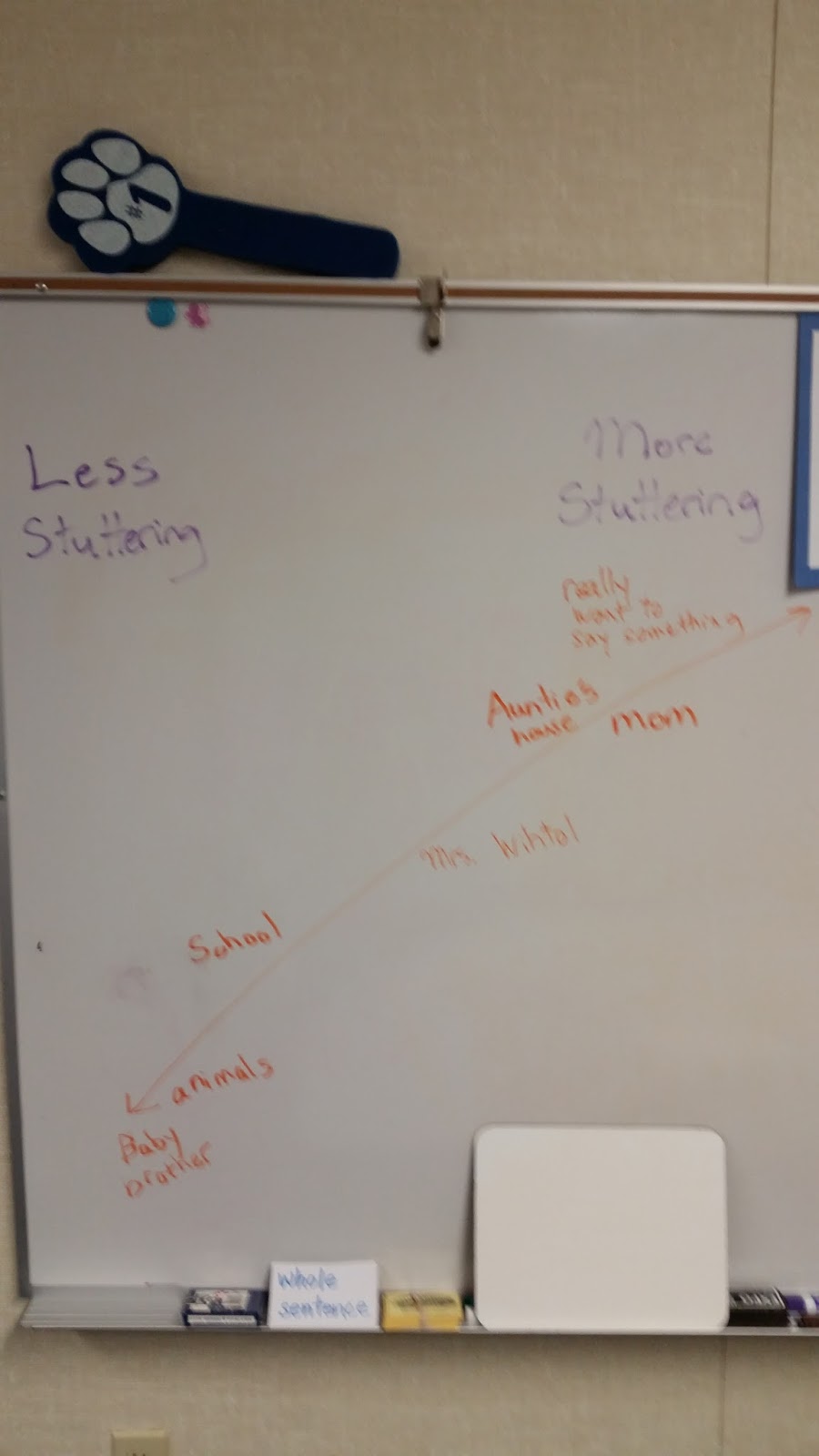
  • Hierarchy of Dysfluencies: I’ve found it interesting that, in my experience, some AWS have made it all the way to high school without ever considering when, where, and with whom they stutter more or less. Some AWS, of course, can tell easily tell you exactly when they have their worst stuttered moments and have spent a great deal of time thinking about the subject. But I’ve also encountered students who seem to have taken the approach that they are powerless in deciding when they stutter, so closely monitoring when they stutter has never been a priority.
fluency hierarchy.jpg
This is a picture of a typical hierarchy I create with students. As you can see, he was able tidentify that he’s most dysfluent when he really wants to say something. But when talking to his baby brother or animals, he’s more fluent. When talking to adults, such as his aunt, mom, and a teacher, his fluency varies more. This activity really helps give AWS ownership of their stutter: they can monitor and make determinations about difficult situations, people, and places. Once they feel in control of difficult situations, they can then be more prepared to use their fluency strategies effectively.

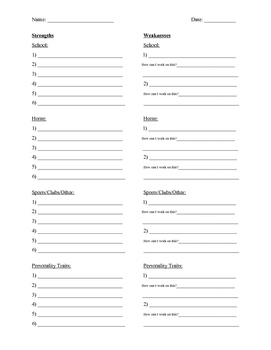
  • Personal Strengths and Weaknesses: I’ve found that AWS often wind up with pretty low self-esteem. One of my AWS is so embarrassed by her highly noticeable secondaries that she texts people she’s standing next to in order to avoid talking. One 17-year-old AWS is convinced that he won’t be able to find a summer job because no one will hire a stutterer. It’s frustrating for me, as a clinician, to see the inherent value and worth in these students when they can’t recognize it themselves!
So, for at least one session, we sit down and write a list of both strengths and weaknesses in all aspects of life (school, home, extracurriculars, etc). I like to focus on the strengths first and build up the students as much as possible. However, I believe there’s real value in identifying weaknesses (besides stuttering) that may actually have a greater impact on their life. For example, all my AWS write stuttering as their biggest weakness. But after some discussion, we might come to realize that their poor grade in math is what will actually keep them from getting into the college they want - not their stuttering! Or perhaps constantly fighting with siblings might be what’s actually causing poor family relations - not their stuttering! We then brainstorm ideas of what they can do to target these weakness (e.g. attend tutoring, be more patient with siblings, etc.) to support the belief that AWS can take control over their own lives.
The students typically reach the realization that, yeah, stuttering does suck to deal with. However, there are many areas of life that can be improved upon. Stuttering is not the only facet of their personality or existence. It’s dangerous for AWS to get caught up in the idea that being fluent would fix everything, because then their stuttering becomes an out-of-control monster to defeat rather than just another part of their life that they can control. Discourage the relentless pursuit of the Fluency Fairy!
You can find the worksheet I use to complete this activity here at my TPT store: https://www.teacherspayteachers.com/Product/Strengths-and-Weaknesses-Fluency-Activity-2548904

  • Exploration of Fluency on Social Media: Let’s face it: we live in a world dominated social media. And like all teenagers, our AWS exist in the epicentre of the social media world. Teenagers today use social media to broadcast all aspects of their lives, and for our AWS, social media can be a where they feel safe. After all, AWS can type a message or snap a picture and maintain the illusion of 100% fluency (remember my student who would rather text than talk?)! But unlike the real world, they have access to an entire network of resources about stuttering and connections to PWS at their fingertips! Below, I’ve outlined a list of online resources I like to expose to my students. I like to introduce a new social media outlet or website to my students at the end of each session in order to give them something to check out over the week. I typically introduce them to the facebook group NSA TwST first, as I think connecting with other teens who stutter is the one of most beneficial things we can do for our AWS.

Recommended Materials:

  • Do You Stutter: A Guide for Teens - This is a great, fairly short but comprehensive guide for teens. I have several copies that I loan out to my students. I’ve found that some of my students do better when they feel like they have some ownership of their treatment and this is a great way to do it.
*Also available in Spanish!


On-line Resources:
  • Stuttering Therapy Resources - I love this website's "resources" tab - it's chock full of therapy ideas, handouts, and videos! This site is run by one of the favorite fluency experts, Nina Reeves, and I highly recommend spending some time familiarizing yourself with the wonderful information kept here.
  • NSA TwsT Facebook Group - A closed group on facebook (moderated by adults, of course) that’s open to teens who stutter. It’s a very supportive community and a great place for AWS to “get their feet wet” by reading what other teens post!
  • www.reddit.com/r/stutter - A forum-type website where PWS ask questions, post treatment ideas, and celebrate achievements. It is monitored to remove abusive content, but users may use profanity, so be careful who you recommend this to.
  • Stutteringhelp.org - The Stuttering Foundation’s Official Website, replete with information, videos, handouts, and resources.
  • Westutter.org - The National Stuttering Association is your go-to website to find opportunities for meet-ups, meetings, and other in-person activities. I took 2 of my students to a local NSA meeting and they reported that meeting adults who stutter really changed their outlook about their future prospects. They even spoke up at the meeting and told the group about themselves - something they swore up and down they wouldn’t do before the meeting!
  • Friendswhostutter.org - Although I have yet to attend a Friends event, this group is really active in promoting opportunities for children and teens who stutter to meet up and worth checking out if there is a group or event in your area!
  • Stuttertalk.com - A great podcast that highlights stories from PWS, SLPs, parents of CWS, researchers, and more. There are lots of podcasts of successful young adults who stutter talking about their lives - highly encouraging for our AWS!

At my school, I inherited several other “pre-packaged, ready to use” fluency therapy tools (you know the type). I really don’t like them for use with the adolescent population - they often have childish illustrations, focus solely on fluency strategies, and the students can tell that it's "off the shelf," impersonal therapy. Most of my students have talked about strategies with a goal of increased fluency for years. Now, as teenagers, they deserve answers about why they stutter, why it can be so hard, and more information about the larger community of PWS that exists in the world. I hope these posts have refreshed your outlook therapy ideas for AWS! Let me know your thoughts in the comments below. Next week, we’ll dive into the topic of new ideas on assessment of AWS.


As always, it doesn't have to be fancy, just keep it fun and functional!

  • Jillian, the No-Frills SLP

Wednesday, June 15, 2016

Functional Fluency: Going Beyond Fluency Shaping Part 1

Fluency is scary!

I remember reading a survey in the ASHA Leader years ago that stated something like 40% of school-based SLPs were comfortable treating fluency disorders. I was stunned! I love fluency disorders! I’m working towards my Board Certification in Fluency Disorders! It’s my favorite part of the field! I wondered - why did other school-based SLPs think it was so scary? I surveyed my SLP friends and came to one main conclusion:


  • Graduate programs don’t properly prepare clinicians for “real world” cases. My friends from various graduate programs all seemed to report that they could teach fluency shaping strategies (e.g. easy onset, pull-outs, light contact, etc.); however, the emotional and cognitive aspects of fluency were foreign. They knew that teaching fluency shaping strategies alone wasn’t enough, but figuring out how to address the other aspects was a daunting prospect.

What about you? Does treating fluency disorders scare you? Let me know why or why not in the comments. For the next three weeks, I’ll be covering assessment and treatment of adolescent fluency disorders in a three part series I’ve named “Functional Fluency.” Hopefully this series of posts will give you some new ideas to test out, regardless of your comfort level with fluency disorders! Let’s get started.


Ms. Hall, Is Anyone Ever 100% Fluent?

How many of you have Adolescents Who Stutter (AWS) on your caseloads with goals that read a little something like this:

“By 10/16, given an initial cue, Bobby will use fluency shaping strategies (e.g. easy onset, light contact, pausing, etc.) to achieve 90% fluency in conversation in the structured speech therapy setting across three sessions as measured by clinician observation and data.”

Wow, 90% fluency in conversation! What an awesome goal! That’s what every anxious, embarrassed, “I-just-want-to-be-normal” stuttering teen desperately wants, right? Unfortunately for their desire to blend in, it’s our job as competent clinicians to NOT give them a goal like this.

“What!?” you may cry, “Why not? What’s wrong with a goal like that? Increased fluency is the ultimate goal, right? We’re only successful when our students stutter less!”

I’ll tell you why I find goals written like this to be problematic and why we need to distance ourselves from the idea that increased fluency is the ultimate goal for AWS.

How many of your AWS have amazing days where they are so wonderfully fluent that you feel like the most competent SLP in the world? How many of your AWS then come back the next week, a dysfluent, anxious mess and you wonder if they’ll ever be close to hitting that 90% target you set at their IEP a few months back?

This is the reality of fluency disorders: Your AWS will have good days and bad days. Unlike articulation and language, where we hope our interventions stick and their disorders remain manageable long after we’ve exited them from services, your AWS are likely going to be managing their views on stuttering and their strategies for attaining fluency forever. If we keep focusing solely on the narrow idea of increasing fluency, we miss the bigger picture.

So What’s the Big Idea?

Hopefully none of what I’m saying is brand new information to you. But I’ve even caught myself writing a % fluent goal for a student; I had to force myself to take a step back from the IEP and examine what exactly it was that this student needed. The main point I think we have to remember when designing a treatment plan for AWS is that our goals and treatment have to address the underlying concerns - not just the outward, fluent behaviors.

Case Study: One day out of the blue, a 17-year-old student came to me after school and said that he had never had speech therapy but that he stuttered and he wanted help. We sat down and started talking about the goals he wanted to accomplish. “I don’t want to stutter anymore,” he told me with perfect fluency. As we talked, it became painfully obvious that he was a textbook covert stutterer - he was obsessed with “how much” he stuttered; he had never spoken to his parents about his stutter; he circumlocuted, used many filler words, and often started sentences with the word “so” in order to get around a block. He knew absolutely nothing about stuttering.

So… did I write him a % fluent goal and hammer techniques until he’s an easy onset and light contact machine who never once stutters? He was already ~98% fluent, so would a 100% fluency goal been truly appropriate? Of course not. But if we’re not measuring an AWS’s success on % fluency, then how are we supposed to measure progress?

Short-Term and Long-Term Goals Ideas:

There’s no right way to answer the question of measuring progress. Below you’ll find some examples that I have used to move beyond the standard fluency % when writing goals. Again, all students are different and you may very well have AWS on your caseload who have needs that stretch far beyond these samples! Trust your clinical judgement; you know your students and their needs, even if it does take a little bit of mental effort to sort it all out.


“By 10/16, Bobby will independently label 5 parts of speech mechanism (i.e. tongue, palate, uvula, trachea, vocal folds) and write a short paragraph describing what happens to the speech mechanism during a stuttered moment as measured by clinician-created probes and student work samples.”

“By 10/16, given moderate clinician support, Bobby will create a short presentation about fluency (e.g. types of dysfluencies, the speech mechanism, famous people who stutter, etc.) and deliver it in a classroom presentation as measured by clinician observation.”

“By 10/16, Bobby will independently write a short essay (3 - 5 paragraphs) discussing (i) different types of dysfluencies (ii) why it is OK to stutter (iii) how it feels when stuttering “takes control” and (iv) how his perception of stuttering has changed since his previous IEP meeting as measured by student work samples.

“By 10/16, Bobby will independently tell three of his new 11th grade teachers that he is a Person Who Stutters as measured by observational data.”

“By 10/16, given minimal clinician assistance, Bobby will research at least 2 stuttering social media groups (e.g.  National Stuttering Association, Stuttering Foundation, etc.) and write a short essay on what he learned about the community of People Who Stutter as measured by student work samples.”

I hope discussing the need to abandon measuring % fluency as progress has helped you to better define the needs of the AWS on your caseload. Next week I’ll discuss my go-to ideas for activities and resources for use when conducting sessions with AWS.

As always, it doesn't have to be fancy, just keep it fun and functional!

  • Jillian, the No-Frills SLP